What Are the Best Soft Contact Lenses in 2026? The answer depends less on a brand name than on your eyes, prescription, and daily routine. A lens that feels comfortable during a quiet morning may become dry after hours of screen work. Small details matter: how easily the lens settles, whether vision stays clear, and how your eyes feel by evening.
Optometrist and contact lens researcher Dr. Jason Nichols has emphasized individual needs in contact lens care. A concise paraphrase of that principle is: “The right lens depends on the wearer’s eyes and lifestyle.” This is a paraphrase, not a verified verbatim quotation. It captures why a 2026 guide should compare daily disposables, reusable lenses, silicone hydrogel materials, and options for astigmatism or presbyopia without declaring one universal winner.
Comfort is important. So is a proper fit. Soft contact lenses differ in moisture, oxygen transmission, edge design, replacement schedule, and cost. A lens may feel smooth at first yet become uncomfortable in dry indoor air. Another may suit long workdays but require careful handling and cleaning. There is no shortcut around an eye examination.
This guide will help readers compare practical features and understand what questions to raise with an eye-care professional. Personal experience can offer useful clues, but it cannot confirm that a lens is safe or suitable for a particular prescription. Expectations also deserve a reality check: even a well-fitted lens may need adjustment.
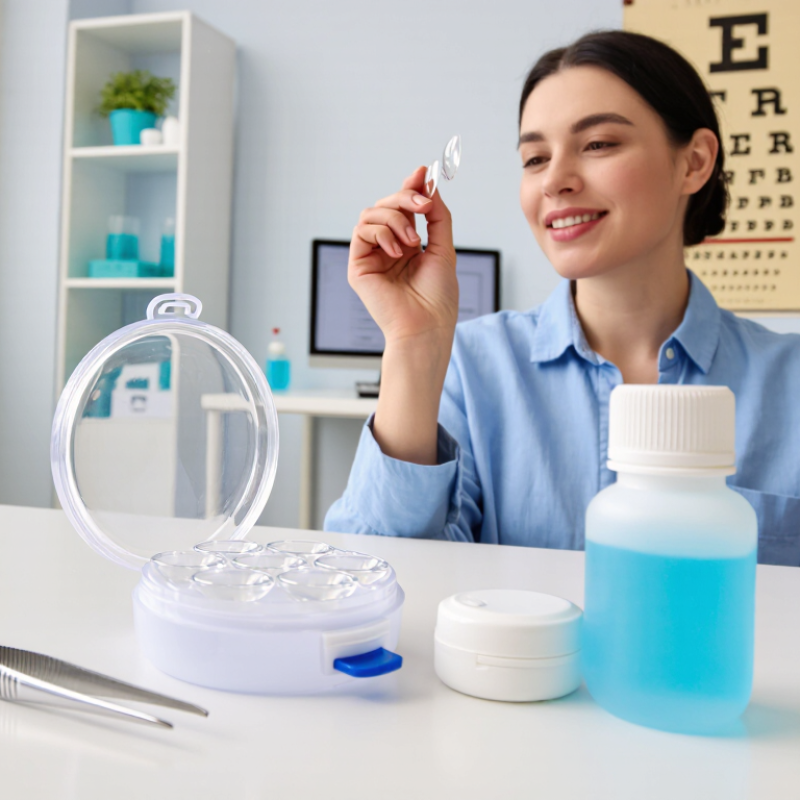
Soft contact lenses correct vision by bending incoming light so it focuses more accurately on the retina. The lens rests on the tear film over the cornea, moving with the eye as you look from a book to a window. For nearsightedness, it shifts focus back onto the retina; for farsightedness, it brings focus forward. Toric designs also address astigmatism by correcting different powers across the eye’s meridians. Multifocal lenses use zones to support near and distance vision. The optics are precise, but the fit is personal.
The 2024 International Contact Lens Prescribing report in Contact Lens Spectrum found that soft lenses made up about 87% of reported contact lens fits. The figure describes participating practitioners’ prescribing, not every wearer worldwide. That matters. A lens can correct a prescription yet still feel dry, move excessively, or blur if its fit or material is unsuitable. An eye-care professional checks lens movement, vision, and corneal health, then adjusts the prescription when needed. A useful caution: comfort alone can mislead. Soft lenses may feel natural while still needing a closer fit assessment. Follow-up checks are part of vision correction, not an optional extra.
Soft contact lenses use hydrogel or silicone hydrogel materials. Hydrogel lenses hold water, while silicone hydrogel generally lets more oxygen reach the cornea. More oxygen is not an automatic comfort guarantee. Surface moisture, lens movement, and an individual’s tear film matter too.
Design determines how a lens corrects vision and fits daily routines. Spherical lenses correct common prescriptions; toric designs address astigmatism, and multifocal designs offer near and distance zones. Wear schedules range from daily replacement to planned reusable cycles. The Contact Lens Spectrum 2023 Annual Report reported daily disposables at about 46% of U.S. soft-lens fits. That figure describes prescribing patterns, not which design suits every wearer.
A lens can feel smooth yet fit poorly. An eye-care professional assesses corneal shape, prescription, and tear-film health before recommending material and design. Measurements matter. Silicone hydrogel’s oxygen advantage may be useful, but dryness or edge awareness can still occur. Real-world comfort deserves follow-up, not guesswork.
Materials and designs used in soft lenses
Silicone hydrogel materials generally have higher oxygen permeability (Dk) than conventional hydrogels. The ranges shown are representative, not universal; oxygen reaching the eye also depends on lens thickness (Dk/t) and fit. Soft lenses may use spherical designs for common refractive errors, toric designs for astigmatism, or multifocal designs for near and distance vision. Ask an eye-care professional which material and design suit your eyes.
In 2026, a top soft contact lens should match the wearer’s eyes, routine, and prescription—not just promise all-day comfort. Oxygen transmission, surface wetting, edge design, and replacement schedule all affect the experience.
A 2023 International Contact Lens Prescribing Survey, published in Contact Lens Spectrum, reported that daily disposables accounted for about 46% of soft-lens fits across surveyed markets. That signals strong clinical uptake, but not universal superiority: the survey describes prescribing patterns, not which lens works best for every person.
Fit matters. An eye-care professional can check movement, coverage, and vision while the lens is on the eye; a lens that feels fine briefly may still cause problems later.
The CDC’s 2014 report in Morbidity and Mortality Weekly Report found that 99% of surveyed U.S. contact lens wearers reported at least one risky hygiene behavior. Convenient replacement can help simplify care, but it does not remove the need for clean hands or proper wear habits.
Comfort varies. Dryness late in the day, redness, or fluctuating vision deserves attention, not a quick switch based on online reviews.
One useful question remains: does the lens stay comfortable through the wearer’s actual day, including screen time and dry indoor air?
Soft lenses should match the eye’s shape, prescription, routine, and tear film. For straightforward nearsightedness or farsightedness, spherical lenses may work well. Astigmatism usually calls for toric lenses, which use a stabilizing design to keep vision clear as the eye moves. For age-related near-vision changes, multifocal lenses can support distance and reading. Adaptation takes time.
Daily disposables suit people who want a fresh pair each day, including some occasional wearers and allergy sufferers. They avoid cleaning steps, but do not solve every comfort problem. Reusable two-week or monthly lenses may cost less over time, provided wearers clean and store them consistently. The 2023 International Contact Lens Prescribing Survey reported more than 20,000 fits across 71 countries, showing how widely fitting choices vary. Its findings, published in Contact Lens & Anterior Eye, describe prescribing patterns—not a guarantee that one lens type suits everyone.
Silicone hydrogel lenses allow more oxygen through the material than conventional hydrogel lenses, which can matter during prescribed wear. Yet higher oxygen transmission does not prevent dryness or irritation.
Not always.
A lens that feels fine at noon may feel gritty by evening. A contact lens professional can assess fit, prescription, and eye health, then recommend a trial. Tear-film problems or sensitive eyes may call for different materials, replacement schedules, or shorter wear. A fitting is not guesswork, though comfort can still take a few adjustments.
The best soft contact lenses in 2026 are the ones that fit your eyes, prescription, and daily routine. A clinician can assess fit and recommend a replacement schedule; comfort alone cannot confirm that a lens is safe. Fit matters most. Daily and reusable lenses suit different needs, so avoid choosing by price or online reviews alone.
Wash and dry your hands before handling lenses. Place each lens on a clean fingertip and check that it is not inside out or torn. Follow its wear and replacement schedule, even when it still feels comfortable.
Never rinse lenses or their case with tap water. Water is not safe. Remove lenses before swimming or showering, and do not sleep in them unless your eye-care professional specifically approves it.
If your eyes become painful, unusually red, light-sensitive, or blurry, remove the lenses and contact an eye-care professional promptly. Do not put a lens back in to “test” whether the irritation has passed. A small case detail is easy to overlook: reusable-lens cases need regular cleaning and replacement according to professional guidance. Lens care can feel fussy, and that is exactly when shortcuts become tempting.
They bend incoming light so it focuses more accurately on the retina. The lens rests on the tear film and moves with the eye.
Spherical lenses correct common prescriptions, while toric designs address astigmatism. Multifocal lenses use different zones to support near and distance vision.
Common materials include hydrogel and silicone hydrogel. Silicone hydrogel generally allows more oxygen to reach the cornea, but that alone does not guarantee comfort.
No. A lens may feel smooth but still move too much or cause blurred vision. Fit matters.
They assess vision, lens movement, coverage, corneal shape, and tear-film health. Follow-up checks can reveal issues that comfort alone may hide.
Not necessarily. Daily disposables made up about 46% of reported soft-lens fits in a 2023 prescribing survey, but those figures do not show what suits each wearer.
Tear-film quality, lens movement, surface moisture, and edge design can all matter. Screen time and dry indoor air may make late-day dryness more noticeable.
Pay attention to redness, fluctuating vision, or persistent dryness, and seek professional guidance. A quick switch based on online reviews may miss the real cause.
Soft contact lenses correct vision by bending light so it focuses more clearly on the retina. Their comfort and performance depend on factors such as material, moisture, oxygen flow, shape, and replacement schedule. In 2026, a top choice is not simply the newest lens, but one that provides clear vision, fits the eye well, feels comfortable throughout the day, and suits the wearer’s prescription and routine.
Different lens designs can address nearsightedness, farsightedness, astigmatism, or age-related difficulty focusing at close range. Choosing the right type requires an eye-care professional’s assessment, since eye shape, tear quality, and lifestyle all matter. Safe wear also means following the prescribed wearing and replacement schedule, washing and drying hands before handling lenses, and using appropriate care products. Never wear lenses longer than directed, and seek professional advice if discomfort, redness, or blurred vision occurs.