1. Strategic Overview of China's Wholesale Contact Lens OEM Manufacturing Industry
The global contact lens market is undergoing a structural transformation driven by direct-to-consumer (DTC) eyewear brands, retail pharmacy expansion, and burgeoning consumer demand for cosmetic color lenses across Europe, the Middle East, and Asia. As global optical buyers re-evaluate their contract manufacturing partnerships, China OEM contact lens manufacturers and factories have emerged as pivotal hubs for high-yield precision optical injection, advanced hydrogel synthesis, and full-stack private label brand development.
Historically concentrated in traditional spectacle lens production, Chinese optical manufacturing ecosystems—specifically within industrial clusters across Jiangsu (Danyang), Zhejiang, and Guangdong—have integrated advanced automated manufacturing systems, high-speed automated visual inspection (AOI), and ISO Class 8 cleanrooms. This technological elevation enables OEM factories to supply medical-grade contact lenses (Class III Medical Devices) that meet strict global regulatory frameworks, including EU MDR (2017/745), US FDA 510(k) clearances, and international ISO 13485 quality standards.
Core Information Gain Insight for Procurement Directors: Modern contact lens contract manufacturing in China has moved far beyond low-cost labor arbitrage. It is now defined by automated cast-molding systems, proprietary silicone hydrogel formulation chemistry, micro-fluidic ink printing technology for cosmetic lenses, and streamlined global lot-traceability logistics.
2. Technical Material Breakdown: HEMA vs. Silicone Hydrogel OEM Technologies
Selecting the correct material matrix is the critical decision when building a private label contact lens line. Chinese OEM factories primarily manufacture across two main chemical architectures: Traditional Hydrogel (Poly-HEMA) and Next-Generation Silicone Hydrogel (SiHy).
Poly-HEMA Hydrogel Lenses
Hydrogel lenses synthesized from 2-Hydroxyethyl methacrylate (HEMA) and cross-linking monomers remain the benchmark for cosmetic color lenses and cost-effective daily/yearly disposables. With water content ranging between 38% and 58%, HEMA-based contact lenses offer immediate initial insertion comfort and excellent mechanical stability during printing processes. The hydration matrix relies on water transport to move oxygen through the lens material to the cornea.
Silicone Hydrogel Lenses (High Oxygen Transmissibility - Dk/t)
For premium daily disposables and extended-wear optical prescriptions, Chinese manufacturers have developed proprietary silicone hydrogel formulations. By incorporating siloxane macromers into the polymer matrix, Silicone Hydrogel lenses achieve significantly higher oxygen permeability ($Dk/t$ values exceeding 100 to 150) compared to traditional hydrogels ($Dk/t$ ~ 20-30). This ensures corneal oxygenation, reduces hypoxia-related complications, and elevates brand authority for optical retail chains.
Interlayer Printing (Sandwich Tech)
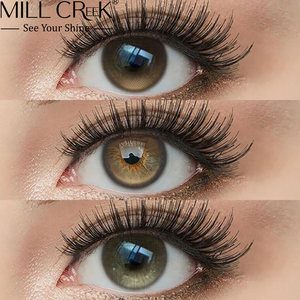
Cosmetic color pigments are encapsulated securely between two clear hydrogel polymer layers. Color inks never come into direct contact with the cornea, preventing pigment leaching and ensuring compliance with international ophthalmic safety rules.
Cast Molding Precision
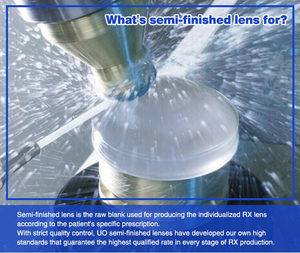
Utilizing high-precision CNC mold tooling with optical surface finishes refined to sub-micron scales. Every single-use plastic mold guarantees consistent base curves ($8.5mm - 8.7mm$) and power accuracy across millions of units.
Hyaluronic Acid Hydration Blisters
Sterile saline solutions infused with natural moistening agents like Sodium Hyaluronate (HA) and Poloxamer to lock in lens moisture, reduce initial insertion friction, and deliver 16-hour wearing comfort for end consumers.
3. Manufacturing Comparison Matrix for Private Label Procurement
When structuring contract terms with OEM factories, procurement teams must align product parameters with target retail pricing, replacement frequency, and consumer expectations. The following matrix details standard manufacturing specifications available across Chinese factories:
| Parameter / Specification | Cosmetic Color Lenses (1-Day / Yearly) | Clear Daily Hydrogel Lenses | Premium Silicone Hydrogel Lenses |
|---|---|---|---|
| Primary Material | HEMA / Poly-HEMA + Color Pigments | Polymacon / Ocufilcon D | Fluorosilicone Hydrogel |
| Water Content (%) | 38% – 42% | 55% – 58% | 45% – 48% (High Internal Wetting) |
| Oxygen Permeability (Dk/t) | 15 – 25 $Dk/t$ | 25 – 35 $Dk/t$ | 100 – 160 $Dk/t$ |
| Color Layer Technology | 3-Tone / 1-Tone Interlayer Sandwich | N/A (Clear / Light Blue Handling Tint) | N/A (Clear / Light Blue Handling Tint) |
| Sterilization Method | Moist Heat Autoclave (121°C) | Moist Heat Autoclave (121°C) | High-Pressure Steam Autoclave |
| Packaging Options | PP Blister Pack + Foil / Glass Vial | Single-Use Foil PP Blister Strip | Ergonomic Easy-Peel Foil Blisters |
| Primary OEM Target | Beauty Chains, E-Commerce Brands | Mass Retail, Drugstores, Pharmacies | Optical Chains, Ophthalmologist Outlets |
4. Future Sourcing & Procurement Trends (2026–2030)
As the optical category evolves, forward-thinking procurement teams must navigate several macro shifts transforming China's OEM contact lens factories:
A. Rapid Expansion of Sustainable & Recyclable Packaging
Environmental regulations across the European Union and North America are forcing brands to reduce single-use plastic waste. Leading Chinese contact lens manufacturers are developing biodegradable polypropylene (PP) blister trays, ultra-thin aluminum sealing foils, and FSC-certified recycled paper outer cartons. Reducing the plastic mass per blister by up to 25% significantly lowers shipping carbon footprints and aligns with global retail sustainability mandates.
B. Integration of Artificial Intelligence (AI) in Inspection
Manual quality checks are no longer viable for high-volume orders. Leading factories now employ automated high-speed visual inspection systems powered by computer vision and deep learning models. These vision systems inspect 100% of manufactured lenses inside the liquid blister phase, detecting edge tears, surface inclusions, peripheral bubbles, and color print misalignments at speeds exceeding 1,200 lenses per minute.
C. Low MOQ Pilot Launches & Agility in Private Labeling
Historically, contact lens contract manufacturing required minimum order quantities (MOQs) of 50,000+ units per SKU, creating significant barriers to entry for emerging brands. Modern Chinese OEM plants now offer modular production lines. Retailers can initiate pilot programs with low MOQs (e.g., 1,000 to 3,000 boxes per SKU), utilizing pre-certified base formulations and custom-printed secondary paper packaging to validate consumer demand before committing to high-volume manufacturing runs.
5. Enterprise Strengths & Private Label Workflow (End-to-End OEM/ODM)
Partnering with an established manufacturing enterprise like kyralens Technology Co., Ltd. streamlines the complex journey from product conceptualization to market-ready retail stock. By consolidating the entire eye care shelf under a unified vendor chain, retail procurement directors reduce vendor management friction while maintaining strict quality consistency.
1. Category Brief & Formulation
We analyze your market position, competitive price tier, and regulatory requirements, helping you select ideal lens materials, hydration agents, and curvature parameters.
2. Custom Artwork & Packaging
From primary blister foil printing to luxury retail cartons, structural cardboard engineering, and multi-language instruction leaflets compliant with target market health authorities.
3. Regulatory Audit & Dossiers
Complete provision of Technical Documentation File (TDF), Declarations of Conformity, ISO 13485 certificates, and sterilization validation reports for smooth customs clearance.