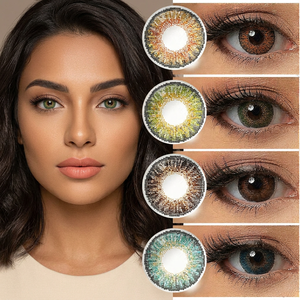
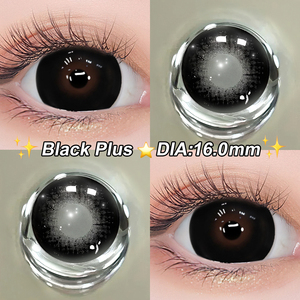
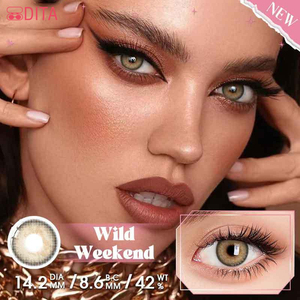
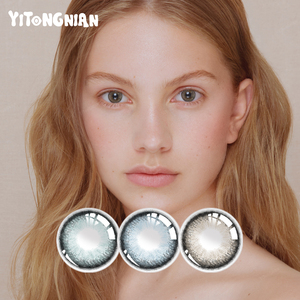
1. Structural Landscape of China's Color Contact Lens Manufacturing Industry
Over the past decade, China has transitioned from a high-volume contract manufacturer into the global epicenter for precision hydrogel polymer engineering and advanced optical aesthetic innovation. Driven by massive investment in automated cast-molding infrastructure, laser-guided edge polishing, and high-speed automated optical inspection (AOI) technology, leading Chinese suppliers now supply top-tier international pharmacy chains (such as Watson's, Rossmann, Kruidvat, and Albert Heijn) with private-label contact lenses and vision care products.
For international buyers, sourcing color contact lenses from China offers a distinct competitive advantage: the seamless fusion of medical-grade polymer chemistry with rapid cosmetic design iteration. Unlike traditional spherical vision lenses, cosmetic color contact lenses demand rigorous micro-encapsulation technology to ensure that pigments never contact delicate corneal epithelial tissue. Premier OEM/ODM suppliers like kyralens Technology Co.,Ltd maintain dual operational footholds—utilizing European compliance expertise paired with state-of-the-art manufacturing facilities—to deliver turnkey solutions spanning daily disposables, monthly cosmetic lenses, lubricating eye drops, and customized retail storage cases.
Bio-Sandwich Encapsulation
Color pigments are locked between two micro-thin layers of biocompatible hydrogel, preventing direct contact with the cornea and eliminating pigment leaching risks.
High Oxygen Flux ($D_k/t$)
Optimized polymer cross-linking using HEMA+NVP co-polymers and Silicone Hydrogel matrices ensures elevated oxygen transmission, reducing corneal hypoxia risks during extended wear.
Double Tapered Edge Design
Precision cast molds produce razor-thin, rounded lens peripheries that minimize tear-film disruption and upper lid friction upon every blink cycle.
2. Polymer Science Breakthroughs: HEMA vs. HEMA+NVP vs. Silicone Hydrogel
Selecting the optimal lens substrate material is the most critical procurement decision for brand owners. Polymer formulation directly influences user comfort, ocular moisture balance, manufacturing yield, and ultimate shelf life. Below is an engineering comparison matrix developed by our R&D technical team:
| Material Classification | Water Content (%) | Oxygen Permeability ($D_k/t$) | Modulus (Rigidity) | Dehydration Resistance | Target Retail Segment |
|---|---|---|---|---|---|
| Standard HEMA Hydrogel | 38% - 42% | 12 - 18 | Low (0.35 MPa) | Moderate | Budget Cosmetic Lenses / Cost-sensitive OEM |
| HEMA + NVP Co-Polymer | 42% - 55% | 22 - 30 | Ultra-Soft (0.28 MPa) | High (Hydrophilic Network) | Premium 1-Day & Monthly Natural Color Ranges |
| Silicone Hydrogel (SiHy) | 45% - 48% | 80 - 110+ | Medium-High (0.50 MPa) | Superior (Siloxane Channels) | Medical-Grade & Extended-Wear Prescription Color Lines |
While standard HEMA remains a reliable material for price-sensitive promotional products, modern consumers increasingly demand HEMA+NVP or Silicone Hydrogel (SiHy) lenses. The incorporation of N-Vinylpyrrolidone (NVP) builds a highly hydrophilic polymer network that locks moisture into the lens matrix, preventing midday eye dryness and end-of-day irritation—a key metric for driving repeat consumer purchases in pharmacy and e-commerce channels.
3. 2026–2030 Global Procurement & Product Development Trends
Procurement managers navigating the color contact lens market must align their product development pipelines with evolving consumer aesthetics and tightening global healthcare regulations. Our market intelligence highlights four macro trends shaping the sector:
Trend 1: Micro-Limbus & Hyper-Natural "Iris-Integrating" Patterns
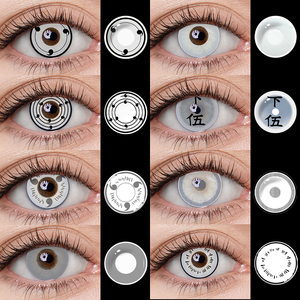
The era of harsh, opaque single-tone lenses is rapidly declining. Modern consumers favor subtle 3-tone and 4-tone radial dot-matrix prints that blend seamlessly with natural iris textures. Lenses featuring soft micro-limbal rings offer natural iris enlargement while preserving depth and realism.
Trend 2: Expansion of Daily Disposable (1-Day) Formats
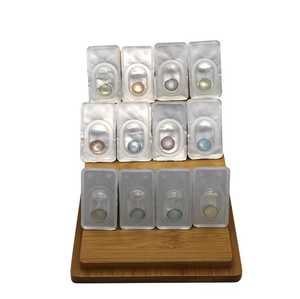
Consumer preferences are shifting aggressively toward daily disposables due to superior hygiene, eliminate the need for cleaning solutions, and minimal infection risks. Automated high-speed blister packing lines in China now allow suppliers to offer cost-competitive 1-day color lenses with low unit costs.
Trend 3: Regulatory Convergence & MDR CE Compliance
The implementation of the European Union Medical Device Regulation (EU MDR 2017/745) has raised the compliance barrier significantly. Color contact lenses—even non-prescription cosmetic variants—are classified as high-risk medical devices requiring full clinical evaluation dossiers, ISO 13485 certification, and complete lot traceability from raw monomer to final blister seal.
Trend 4: Sustainable Eco-Packaging and Bio-Based Materials
Leading global retailers are demanding reduced plastic usage in blister secondary packaging. Manufacturers are responding with recycled paperboard cartons, soy-based inks, and optimized foil lidstock that decreases material waste by up to 25% without compromising sterile seal integrity.
Ready to Launch Your Private Label Eye Care Line?
Consult with our OEM/ODM product managers to receive complimentary product samples, regulatory documentation dossiers, and factory-direct pricing quotes.
Get a Quote4. Essential Quality Assurance (QA) Checklist for B2B Importers
When vetting Chinese exporters and contract manufacturers, purchasing directors should perform a rigorous 5-point quality audit prior to issuing purchase orders:
- Monomer Purity & Bio-Compatibility: Verify that raw materials (such as HEMA, EGDMA, NVP) are medical-grade, free of unreacted monomers or toxic residual catalysts.
- Automated Optical Inspection (AOI): Ensure 100% of finished lenses undergo high-resolution digital camera inspection to detect tears, edge burrs, bubbles, and micro-inclusions.
- Sterilization Protocol: Confirm batch sterilization via high-pressure moist heat autoclaving ($121^\circ\text{C}$ for minimum 20 minutes) with physical and biological indicator verification.
- Blister Seal Integrity & Leak Testing: Demand vacuum decay testing and dye penetration studies to verify that aluminum foil blister seals remain 100% sterile throughout their 5-year shelf life.
- Regulatory Dossiers & Traceability: Ensure the factory provides complete Lot History Records (LHR), Certificates of Analysis (COA), and country-specific labeling compliance (multilingual warnings, UDI barcodes).